Research Security
AU has implemented guidelines designed to protect research from being misused. The goal is for researchers to work as openly as possible - and as securely as necessary.
If you are interested, you can read more by clicking the “URIS guidelines” button.
Below you can read about the mandatory project screening that must be carried out before the start of research projects, background screening, travel to high-risk countries, guidelines on secondary employment and how you should handle suspicious inquiries.
Project screening
Project screening
AU has introduced guidelines for the risk assessment of research and project collaborations that involve applications for external funding and/or written collaboration agreements.
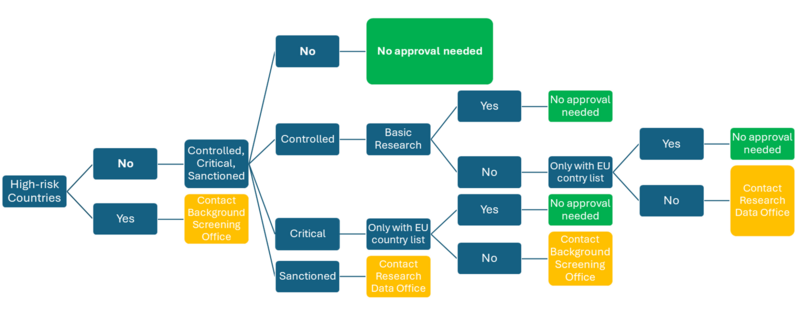
The decision tree below illustrates how you, as a member of staff or as a manager, are required to carry out a risk assessment of a project.
The decision tree also provides information on the circumstances in which you must contact the Background Screening Office and the Research Data Office, respectively.
Their contact details can be found on the right-hand side.
Background screening
Background screening
A background screening must be conducted if the candidate does not hold citizenship in one of the pre-approved countries (all EU countries, the United Kingdom, the United States, Norway, Switzerland, Canada, Australia, New Zealand, Japan, Iceland, and Liechtenstein).
This applies, among other situations, to recruitment, PhD scholarships, and guest visits. Changes between research environments may also lead to a background screening.
Background screening of guests and interns
Background screening of guests and interns is not supported by the recruitment system.
Please contact the secretariat (Helle Elbæk, hea@mpe.au.dk), who can help guide you through the process described here.
Further information
You can read more about background screening here.
Travel to high-risk countries
Travel to high-risk countries
At present, Iran, Russia and China are defined as high-risk countries. Travel to high-risk countries must be risk assessed and approved in writing by the Head of Department.
When traveling to high‑risk countries, it is particularly important that you use a dedicated laptop and mobile phone (IT travel kit) provided by Nat-Tech IT.
You can read more about what an IT travel kit includes and how to borrow one below.
You can read more about travel to high-risk countries here.
Guidelines on secondary employment
Guidelines on secondary employment
Academic staff are required to declare any secondary employment annually where it is related to their role at Aarhus University.
If the secondary employment is related to a high-risk country, or falls within “critical” or “controlled” research, the employee must report the secondary employment to the Head of Department no later than 14 days in advance.
If the secondary employment is deemed compatible with the position at AU, AU’s standard guidelines on secondary employment will apply.
You can read more about the general guidelines on secondary employment here.
Suspicious inquiries
Suspicious inquiries
If, as a researcher, student, or employee at MPE, you have received an inquiry that seems suspicious, you are welcome to contact Morten Flarup Andersen, Head of Secretariat (mfa@mpe.au.dk) or your manager.
This may involve direct or indirect threats or seemingly benign approaches from states or individuals seeking to gain access to information or otherwise exert influence.
If you have experienced something similar or find yourself in a dilemma, please reach out to Morten Flarup Andersen or your manager, who will help you handle the situation.
Researchers who wish to report such incidents anonymously can do so through AU’s whistleblower scheme.
Onboarding
Onboarding
It is important that new employees are made aware that a focus on research security and complying with the URIS guidelines are part of their responsibility as university employees.
It is particularly important that new employees undertake a course on responsible research practice.
Offboarding
Offboarding
It is important that you take research security into account when offboarding members of staff. This is included in the checklist for offboarding members of staff at AU.
It is particularly important that you:
- Remove their access rights or make a clear agreement on when their access rights will be removed. If you agree to extend their access rights temporarily, this should be for a short period, and you must agree clear follow-up measures. See AU IT’s checklist for offboarding.
- Consider their access to research data. When a member of staff leaves AU, it’s important that all parties comply with any existing agreements on their rights to research data - or that new agreements are made regarding what will happen to the research data collected in projects that they were either responsible for or participated in.
